

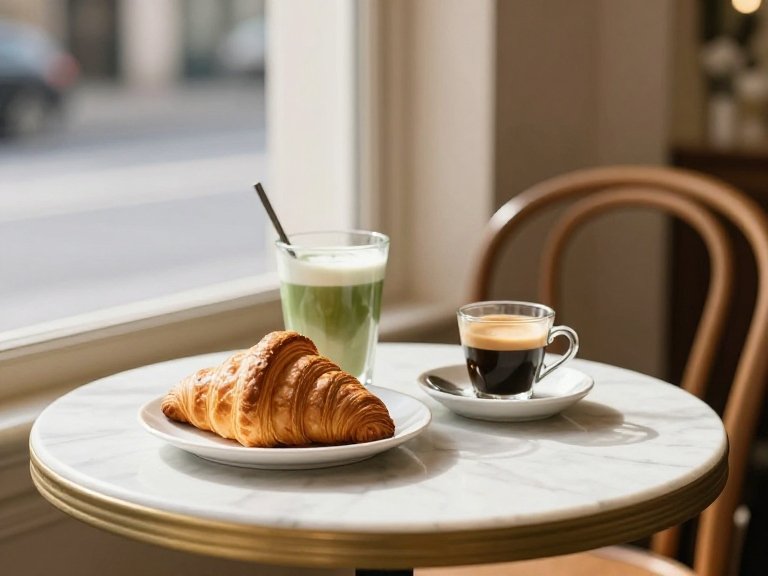
It’s a drizzly Saturday and you’ve got nowhere to be. You duck into a small cafe, grab a window seat and order a croissant and a coffee. Forty-five minutes later you haven’t touched your phone. That’s the pull of a French cafe, and it’s why the format keeps getting reinvented.
So what’s changing, and what’s staying put? This article looks at the classic experience, the 2026 trends reshaping it, and how to spot a good one.
What makes a French cafe different?
Pace, mostly. The quick takeaway isn’t the point here. A table, a drink and an hour you don’t have to justify are.
Slow by design
UNESCO gives a clue about the philosophy. It inscribed the gastronomic meal of the French on its Intangible Cultural Heritage list in 2010, describing it as a social practice that brings people together around the pleasure of taste. A cafe isn’t a formal feast, but the same spirit runs through it: good food, unhurried company. UNESCO also lists buying good products, preferably local ones, among the practices of that tradition. That habit shows up on cafe menus too, in seasonal fruit tarts and bread from a nearby baker.
Here’s a small scenario. Two friends meet at ten, order one coffee each and one pastry to share. By noon they’ve ordered two more coffees and a quiche. Nobody rushed them.
The classic menu
The core hasn’t moved much. Typical fare looks something like this:
- Croissants, pains au chocolat and other buttery viennoiserie
- Café au lait, espresso and a simple filter coffee
- Croque monsieur and quiche
- Tartines, which are open sandwiches on good bread
- Tarts and éclairs
Short menus are a good sign. A kitchen that does fewer things usually does them better.
Why is everyone talking about cafe culture again?
Because France itself is worried about losing its cafes. In January 2026, The Connexion reported that President Emmanuel Macron had backed a campaign to put French bistros and cafes on UNESCO’s Intangible Cultural Heritage list. The Association des Bistrots et Cafés de France launched the push in 2024.
The numbers behind it are striking, but they come from the campaign, not an official count. Its president, Alain Fontaine, says France had around 500,000 cafes and bistros at the start of the 20th century and fewer than 40,000 today. He links the decline to a loss of everyday social life.
Worth knowing: the article describes an advocacy campaign, not a formal nomination that’s been assessed. The association has also set 5 June 2026 as a National Day of Cafes, Bistros and Terraces.
My take? Cafes matter beyond the coffee. Wherever you live, a place where people sit and talk is rarer than it used to be, and that gives the slow, sit-down model new appeal.
What’s changing on the menu?
Quite a bit, though mostly at the edges. The croissant isn’t going anywhere. Around it, menus are picking up new flavours, new drinks and a bigger brunch focus.
A note on the data. Food analytics firm Tastewise published France menu trends in June 2026, based on its own platform and not independently verified. Its figures are 12-month changes in consumer interest, so treat them as signals, not sales counts.
Brunch keeps growing
Tastewise lists brunch as one of the fastest-growing occasions in France, with consumer interest up 83.3 percent over 12 months. That fits what many cafes already do: egg dishes, tartines and pastries served late into the morning.
Picture a table split between sweet and savoury. One person orders a tartine with eggs, the other a pastry and a latte, and they swap halves halfway through. An all-day brunch menu suits that way of eating.
Pastries with a twist
Classic viennoiserie is steady, with Tastewise reporting a 12.5 percent rise in interest. The bigger movement is in flavour. Smoked flavours are up 127.7 percent, and the report gives an example of a pastry with a smoky note.
Some purists will wince. I’d say try one anyway. A good twist respects the dough, and a bad one hides it.
Drinks beyond espresso
Here’s where the biggest numbers sit. Matcha is up 160.9 percent in the Tastewise data, with its strongest presence in brunch and cafe settings. Lattes are up 62.6 percent, and the report describes them as a vehicle for matcha and other flavours.
It’s a funny pairing at first: a Japanese-style green tea latte beside a butter croissant. But it works, because the bitterness cuts the richness.
Plenty of Australian cafes already borrow from this playbook, so you’ve probably seen a version of it near you.
How can a cafe blend the classic and the modern?
Without losing its soul, is the real question. Trends are tempting, and a menu stuffed with every new flavour usually ends up confused.
A few habits help:
- Keep the classics perfect before adding anything new
- Rotate one seasonal twist at a time, so regulars notice the change
- Pair drinks and pastries on the menu, such as a matcha latte with a plain croissant
- Use local produce where possible, in the spirit of the UNESCO-listed tradition
- Design the room for lingering, with comfortable seats and space between tables
- Say what’s baked in-house, because customers care
Picture a cafe that keeps its croissant and quiche untouched but adds a single smoked pastry each season. Regulars get the comfort they came for and a reason to try something new. That balance is harder than it looks.
The flip side is real. Trend items can be hits or misses, and a failed experiment wastes ingredients and goodwill. Test small, ask customers, and drop what doesn’t sell.
Pros and cons of trendy twists
- Pro: new items give regulars a reason to return
- Pro: social-friendly dishes get shared online
- Con: more ingredients mean more waste if they don’t sell
- Con: a crowded menu can blur what the cafe does best
My blunt tip: one great twist beats five average ones.
How do you spot a good French cafe?
Look past the striped awnings and bentwood chairs. A real French cafe earns its name through what comes out of the kitchen and how it treats your time. Run through this checklist before you commit:
- Ask whether the pastries are baked on site or bought in.
- Check that the menu is short and focused.
- Taste the coffee before judging anything else.
- See whether people are lingering or being moved along.
- Notice if the bread tastes like it matters.
- Look for something seasonal on the specials board.
My blunt opinion: if the croissant is pale and bready, walk out. Everything else on the menu will be the same story.
And don’t treat the decor as proof. A cafe can look like a Paris postcard and still serve a frozen pastry.
What should you order first?
If you’re new to the format, a simple route works best. Start small, then build.
- A croissant, plain, to judge the baking
- A café au lait or espresso, depending on how strong you like it
- Something savoury, such as quiche or a croque monsieur
- A tart or éclair to share
Take a couple ordering for the first time. They get a plain croissant each, one coffee, one matcha latte and a shared tart. They can see the classic and the trend in the same sitting. It’s a decent way to learn what a place does well without ordering the whole menu.
Pairing matters too. A bitter espresso cuts through a buttery pastry, while a milky coffee softens a tart or something smoky. Ask the staff what they’d pair with your order. They usually have a view.
If you want the full set, ask about the coffee and pastries options and which items are made that morning.
Mistakes people make
- Ordering everything at once, then eating it cold
- Assuming it’s all dessert and skipping the savoury dishes
- Rushing out in 20 minutes
- Judging the cafe by its decor alone
French cafe FAQs
What’s the difference between a French cafe and a bistro?
Loosely, a cafe leans towards coffee, drinks and lighter food, while a bistro serves heartier meals. In practice the lines blur, and the French campaign for UNESCO recognition groups the two together.
What do you eat at a French cafe?
Pastries and coffee, mainly. But many cafes also serve savoury items such as quiche, croque monsieur and tartines, particularly around brunch. If you’re unsure, ask what’s fresh that morning. Staff tend to love that question, and the answer usually beats whatever you’d have picked blind.
Why do French cafes feel slower than regular coffee shops?
Because they’re designed for sitting. The culture treats a table as a place to talk, not a queue to clear. UNESCO’s description of the French gastronomic meal puts togetherness and the pleasure of taste at the centre, and a cafe borrows that attitude in a smaller, everyday way. If you want to enjoy it, leave your schedule at the door and give yourself an hour. You can read UNESCO’s description of the gastronomic meal of the French for the full background.
The bottom line
The format is changing at the edges and holding firm at the core. Brunch, matcha and flavoured pastries are growing, while the slow table and the good croissant remain the point.
So take your time. Order something classic and something new and see which one wins. Notice how the room feels, too, because atmosphere is half the product. A place where people sit, talk and stay a while is doing something right, whatever the menu says. When you’re ready to find a French cafe worth lingering in, start with one that bakes its own.



