

In high-risk industrial environments, the decisions made about lighting carry consequences that go well beyond visibility. The wrong fitting in the wrong environment does not simply fail to illuminate the workspace adequately. In a hazardous area, it can introduce a source of ignition that triggers a catastrophic incident.
This is a reality that experienced procurement and safety professionals understand well. But it is also an area where the gap between what is required and what is actually specified on site remains wider than it should be. Explosion proof LED lighting is still treated by some operators as a premium add-on rather than a non-negotiable element of the safety infrastructure, and the consequences of that mindset show up in compliance failures, unplanned maintenance events and, in the worst cases, serious incidents.
For industrial buyers who are responsible for specifying or upgrading lighting in hazardous environments, understanding how explosion proof LED systems work, what the key technical requirements are and what to look for when evaluating solutions makes a genuine difference to both safety outcomes and operational performance over the long term.
Key Insight
In a hazardous area, lighting is not a utility. It is a safety system, and the standard it is specified and maintained to directly influences the risk profile of everyone working in that environment.
Understanding Hazardous Area Classifications
Before any lighting specification can begin, the environment needs to be correctly classified. Hazardous area classification is the process of defining where flammable gases, vapours, dusts or fibres are present and at what frequency, which in turn determines the level of protection required from any electrical equipment installed in that zone.
The internationally recognised classification system used across Australian industrial and mining operations divides hazardous areas into zones based on the likelihood and duration of an explosive atmosphere being present:
- Zone 0 and Zone 20 represent environments where an explosive atmosphere is present continuously or for long periods during normal operations. Zone 0 applies to flammable gases and vapours, while Zone 20 applies to combustible dust. These are the most stringently controlled environments and require the highest level of equipment protection.
- Zone 1 and Zone 21 cover environments where an explosive atmosphere is likely to occur periodically during normal operations. The majority of enclosed process areas in chemical, oil and gas and mining facilities fall into this category.
- Zone 2 and Zone 22 apply to environments where an explosive atmosphere is unlikely to occur during normal operations but may be present under abnormal or fault conditions. While the risk is lower, appropriate certification is still required for all electrical equipment installed in these zones.
The zone classification of each area on a site must be formally documented as part of the site’s hazardous area register, and all electrical equipment installed in those areas must be certified to the appropriate protection level for that zone. Lighting installed outside its certified zone classification is a compliance failure regardless of how well it performs technically.
For buyers who are not certain about the classifications that apply to specific areas of their site, engaging a qualified hazardous area assessor before specifying lighting equipment is the most important step in the process.
What Explosion Proof Actually Means in Practice
The term explosion proof is widely used but frequently misunderstood by people who encounter it outside a specialist context. It does not mean the fitting is designed to withstand an external explosion or that it is indestructible under blast conditions. The term has a specific technical meaning that is important to understand when evaluating equipment.
An explosion proof fixture is engineered to contain any ignition that occurs inside the fitting and prevent it from propagating to the surrounding atmosphere. The design assumes that flammable gas or dust may enter the enclosure and that an internal ignition event may occur. The protection lies in the fixture’s ability to extinguish that event internally and prevent the flame or heat from escaping through the enclosure seals, joints or other openings in a form that could ignite the external atmosphere.
The engineering principles that make this possible include:
- Robust sealed enclosures with flame paths engineered to cool any escaping gases below their ignition temperature before they can reach the external atmosphere
- Precise control of surface temperatures to ensure the external surfaces of the fitting never reach the ignition temperature of the surrounding atmosphere under any operating or fault condition
- Impact-resistant materials and construction that maintain the integrity of the enclosure under the physical stresses of the operating environment
- Certified compliance with recognised international standards including IECEx, which applies globally, and ATEX, which applies in European markets but is widely referenced internationally as a benchmark
When a fitting carries valid certification for the zone it is installed in, the buyer has documented assurance that the protection design has been independently tested and verified against those standards. Uncertified equipment, regardless of how well it is constructed, does not provide that assurance and does not meet the legal requirements for installation in a classified hazardous area.
Why LED Technology Has Become the Industry Standard in Hazardous Areas
Traditional lighting technologies including metal halide, high-pressure sodium and fluorescent fittings were used in hazardous environments for decades, and many older facilities still operate with these systems. They were adequate for a period when the alternatives were limited. Against modern LED technology, they compare poorly on almost every relevant dimension.
The shift to explosion proof LED lighting across industrial sectors has been driven by a combination of performance improvements and the practical realities of operating in demanding environments. The key advantages that have made LED the preferred technology include:
- Energy efficiency that delivers the same or higher light output at significantly lower power consumption, which in large-scale operations translates to meaningful and ongoing reductions in energy costs across the site
- Lower heat generation that reduces the thermal load on the fitting and the surrounding environment, which is directly relevant in hazardous areas where surface temperature control is a critical safety requirement
- Extended operational lifespan of 50,000 hours or more, which substantially reduces the frequency of maintenance interventions. In hazardous environments where every maintenance task in a classified zone carries risk and disrupts operations, reducing that frequency has both safety and efficiency value
- Instant illumination with no warm-up time, which is critical in emergency scenarios, rapid shutdown situations or any circumstance where reliable immediate light is needed without delay
- Robust performance under vibration, temperature cycling and other environmental stresses that degrade traditional light sources significantly faster than LED technology
For sites that are currently operating with older technology, the total cost of ownership comparison between continuing to maintain existing fittings and upgrading to LED almost always favours the upgrade when the full picture of energy costs, maintenance frequency and operational disruption is considered over a realistic time horizon.
Key Technical Specifications to Evaluate When Specifying Explosion Proof LED Lights
Not all explosion proof LED fittings are equivalent, and specifying the right solution for a particular environment requires working through the technical requirements systematically rather than simply selecting a certified product and assuming it will perform adequately.
The specifications that most commonly determine whether a fitting is genuinely suited to a specific hazardous environment include:
- Zone certification matching the specific zone classification of the installation area. A fitting certified for Zone 2 is not appropriate for a Zone 1 area, and the certification documentation should be reviewed carefully to confirm it covers the specific gases or dusts present in the environment.
- Ingress Protection rating, expressed as an IP rating, which indicates the degree of protection the enclosure provides against solid particles and liquids. IP66 indicates complete dust exclusion and protection against powerful water jets. IP67 adds protection against temporary immersion. In mining and processing environments where wash-down procedures are routine, a minimum of IP66 is typically required.
- Surface temperature classification, which specifies the maximum temperature the external surfaces of the fitting will reach under any operating condition. This must be below the ignition temperature of the specific gas or dust present in the environment, and the T-class rating of the fitting must correspond to the requirements of the zone classification.
- Construction materials and their suitability for the chemical environment of the site. Marine-grade aluminium alloys are commonly used for corrosion resistance. Tempered or borosilicate glass lenses provide impact resistance without introducing static charge risks. In environments with specific chemical exposure, material selection requires careful consideration.
- Mounting configuration compatibility with the physical installation requirements of the site, including ceiling, wall, pendant and pole mounting options and the structural load ratings applicable to each.
Buyers who are specifying lighting for a new installation or an upgrade should also consider the practical aspects of long-term maintenance, including access to replacement components, the technical support available from the manufacturer and whether the product range is likely to remain available over the expected service life of the installation.
The Industries Where Explosion Proof LED Lighting Has the Greatest Impact
While the requirement for explosion proof lighting applies across any environment that meets the definition of a classified hazardous area, some industries and applications place particularly high demands on both the performance and the certification compliance of their lighting systems.
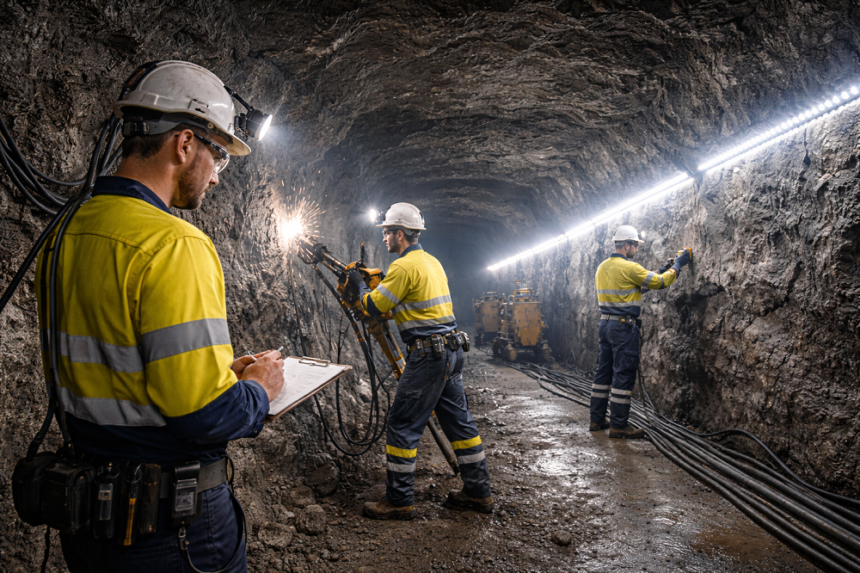
Underground mining operations present some of the most demanding conditions for any lighting equipment. The combination of confined spaces, continuous dust generation, groundwater ingress, mechanical vibration from heavy equipment and blasting activity, and the potential presence of combustible gases creates an environment that tests every aspect of a fitting’s construction and certification. The visibility requirements in these environments are also significant, with lighting needing to support safe navigation, equipment operation and hazard identification across extended operational periods.
Oil and gas facilities including refineries, offshore platforms, pipeline infrastructure and storage terminals operate in environments where the concentration of flammable vapours can vary with process conditions and where the consequences of an ignition event are severe. The classification requirements in these environments are typically stringent, and the expectation from both regulators and operators is that every piece of electrical equipment installed in a classified area carries current, verified certification.
Chemical processing plants present a particularly complex specification challenge because the range of flammable substances present varies significantly between facilities and can change with process modifications. Lighting specifications in these environments need to be reviewed carefully against the specific substances and concentrations involved rather than applying generic assumptions about what is required.
Grain handling, flour milling and other dust-heavy processing industries are sometimes underestimated in terms of their hazardous area requirements. Combustible dust environments are classified under the Zone 20, 21 and 22 system and carry explosion risks that are in some respects more difficult to manage than gas environments because dust accumulation is ongoing and the ignition characteristics of fine particles can be difficult to predict. Explosion proof lighting certified for the relevant dust classifications is required in these environments.
The Consequences of Inadequate Specification in Hazardous Areas
The consequences of installing inadequate lighting in a hazardous area extend well beyond the initial compliance failure and create ongoing operational and safety risks that compound over the life of the installation.
From a regulatory perspective, operating electrical equipment in a classified hazardous area without the appropriate certification is a breach of Australian workplace health and safety legislation. Regulators including state mining departments and WorkSafe authorities have the power to issue improvement notices, prohibition notices and significant financial penalties for non-compliance. In the event of an incident, inadequate equipment specification is a factor that will be scrutinised closely in any investigation and that has direct implications for legal liability.
From an operational perspective, fittings that are not genuinely rated for the conditions in which they are installed will fail at a higher rate than properly specified equipment, increasing the frequency of maintenance interventions in zones where every entry carries risk. The cost of managing that maintenance cycle over time is invariably higher than the cost savings that appeared attractive when the inadequate equipment was initially selected.
From a safety perspective, the most serious consequence is the one that cannot be quantified in advance: a fitting that fails in a way that introduces an ignition source into an explosive atmosphere. The risk of that outcome is the reason explosion proof certification exists, and the reason that compromising on it is genuinely unacceptable in a classified hazardous area.
Key Takeaways
- In classified hazardous areas, lighting is a safety system that must meet specific certification requirements rather than a utility that can be specified on the basis of price or general industrial suitability
- Hazardous areas are classified into zones based on the likelihood and duration of an explosive atmosphere being present, and all lighting must be certified to the appropriate protection level for the specific zone in which it is installed
- Explosion proof means the fitting is engineered to contain any internal ignition event and prevent it from propagating to the surrounding atmosphere, not that the fitting can withstand an external blast
- LED technology has become the industry standard in hazardous areas because of its combination of energy efficiency, lower heat generation, extended lifespan, instant illumination and robust performance under demanding environmental conditions
- Key technical specifications to evaluate include zone certification, IP rating, surface temperature classification, construction materials and mounting configuration compatibility
- The consequences of inadequate specification include regulatory penalties, higher maintenance costs, operational disruption and, most seriously, the risk of an ignition event in an explosive atmosphere
Related Reading
Site managers and procurement professionals looking to understand the full scope of lighting requirements for their specific environment can explore how Mineglow’s range of explosion proof LED fittings are certified and designed for the conditions present in mining, oil and gas and processing facilities.
For operations that are reviewing their existing lighting infrastructure, understanding how modern LED technology compares to older fittings on total cost of ownership, including energy, maintenance and operational continuity, is a useful starting point for building the business case for an upgrade.
If the hazardous area classifications on your site have not been reviewed recently, speaking with a specialist about the relationship between zone classification, certification requirements and the current state of your installed lighting is worth doing before any new specification work begins.
Frequently Asked Questions
What is the difference between explosion proof and intrinsically safe lighting?
Explosion proof and intrinsically safe are two different approaches to preventing ignition in hazardous areas. An explosion proof fitting is designed to contain any ignition that occurs inside the enclosure and prevent it from reaching the external atmosphere. An intrinsically safe system is designed to operate at energy levels low enough that it cannot produce a spark or heat sufficient to cause ignition under any condition, including fault conditions. Explosion proof fittings are typically used for general hazardous area lighting because they can operate at the power levels needed to achieve adequate illumination, while intrinsically safe systems are more commonly used for low-power instruments and control equipment.
How do I choose the right explosion proof LED light for my hazard zone?
The starting point is the zone classification of the area where the fitting will be installed. The fitting’s certification must match that zone classification and must specifically cover the type of hazardous atmosphere present, whether gas, vapour or dust, and the substance group that applies. Beyond certification, the IP rating, surface temperature classification, construction materials and mounting configuration all need to be evaluated against the conditions of the specific installation. For complex sites or where there is any uncertainty about the applicable requirements, working with a specialist supplier who has experience in the relevant industry is the most reliable approach to getting the specification right.
Are explosion proof LED lights more expensive than standard industrial lighting?
The upfront cost of explosion proof LED fittings is higher than standard industrial lighting, reflecting the engineering, materials and certification processes involved in producing equipment suitable for classified hazardous areas. However, when the comparison is made on a total cost of ownership basis over a realistic service life, the higher upfront cost is typically offset by lower energy consumption, longer service life, reduced maintenance frequency and the avoidance of the compliance and safety costs associated with inadequate specification. For operations where lighting maintenance in hazardous zones carries significant risk and operational disruption, the long-term case for properly specified LED fittings is generally very strong.
Lighting That Meets the Demands of the Environment
Hazardous area lighting is one of those specifications where the consequences of getting it wrong are severe enough that compromise is genuinely not an option. The standards exist for good reasons, the certification requirements are enforceable and the risk they are designed to manage is real. For any operator responsible for a classified hazardous area, the lighting installed in that environment should be specified to the same standard as every other element of the safety infrastructure.
The shift to explosion proof LED technology across industrial sectors reflects both the technical advantages of the technology and the growing expectation from regulators and operators alike that hazardous area equipment should provide the highest available level of reliability, safety and long-term performance.
Mineglow designs and manufactures explosion proof LED lighting solutions built for the specific demands of mining, oil and gas, tunnelling and industrial processing environments. If you are reviewing your current lighting or planning a new installation in a classified hazardous area, our team would be glad to help you work through the specification requirements and identify the right solution for your site.



